Why Your 'Good' Cardigan Pills Within a Month (And How to Stop It)
Price doesn't predict pilling. Fiber length, yarn twist, knit density, and the blend on the label do, and you can test for them before you buy.
You paid more for this cardigan on purpose. It felt soft in the store, the label said wool, and within a month the underarms and sides are covered in small fuzzy balls. Price is a poor predictor of pilling: what decides it is how long the fibers are, how tightly they're spun and knit, and what they're blended with. Once you know what to look for, you can spot a pilling-prone knit before you buy it and slow the damage on the ones you already own.
What a pill actually is
Photo by Karolina Ostrzolek via Pexels
Yarn is a bundle of individual fibers twisted together. Every fiber has two ends, and some of those ends sit on the surface of the yarn. When the fabric rubs against something, loose ends work free, tangle with neighboring loose ends, and roll into a small ball. That ball stays attached because some of its fibers are still held in the yarn.
Two things follow from that. Shorter fibers mean more ends per inch of yarn, so more material available to work loose. And anything that lets fibers move, like a loose twist or an open knit, makes it easier for those ends to escape. Neither shows up on a price tag.
Why the soft one pills fastest
The quality you notice most in a store is softness, and softness often works against durability. Yarns are frequently spun with less twist, or the fabric is brushed, to make a knit feel plush and lofty. Both leave more fiber ends free at the surface, which is exactly what produces pills.
That's why a cashmere cardigan can pill faster than a plain cotton one at half the price, and why a cheap acrylic cardigan can look worn after a few outings too. Price tells you something about the fiber's market value. It tells you very little about fiber length, twist, or knit density. Treat the price tag as irrelevant to this question and look at the garment itself.
What the fiber label tells you
 Photo by Engin Akyurt via Pexels
The label won't tell you fiber length, but the fiber content tells you what kind of pilling to expect, which matters as much as how much.
- Natural fibers on their own (wool, cashmere, cotton, alpaca). These fibers are relatively weak, so pills tend to break away over time instead of building up indefinitely. Many natural-fiber knits pill most in their first stretch of wear, as the loosest fibers work out, and then calm down.
- Synthetics (acrylic, polyester, nylon). These fibers are strong. A pill made of them doesn't break off; it stays anchored until you remove it. Acrylic in particular is known for pilling heavily and persistently.
- Natural fibers blended with a synthetic. A small amount of nylon or polyester is often added for strength. The trade-off is that the strong synthetic fibers can hold loose natural fibers in place, so pills that would have fallen off a pure wool knit stay put.
A simple decision rule: if the cardigan is mostly acrylic, assume it will pill and need regular maintenance. If it's a single natural fiber, expect early pilling that should taper. If it's a natural/synthetic blend, judge it on the in-store checks below, because the label alone won't save you.
The three-check test before you buy
Fiber length isn't printed anywhere, but you can test for the results of it in under a minute.
The rub test. Find an inconspicuous spot, like the inside of a side seam or the underside of a cuff, and rub the fabric firmly against itself between your thumb and fingers for about ten seconds. If fuzz is already lifting or tiny balls are starting to form, the garment will pill at the underarms within weeks.
The light test. Hold a single layer up to the store lighting. If you can see clearly through the gaps between stitches, the knit is loose, and the fibers have room to move and migrate to the surface. A denser knit holds them in.
The stretch test. Gently stretch a small section crosswise and let go. A well-made knit snaps back. One that stays slightly distorted is loosely knit or loosely spun, both pilling risks.
Look at the surface too. A fuzzy halo over the stitches means loose fiber ends are already sitting on top. A smooth, clearly defined stitch is a better sign than an extra-soft fuzzy one.
- Pilling is decided by fiber length, yarn twist, and knit density, not by what the cardigan cost.
- Synthetic fibers, alone or in blends, hold pills on the fabric; pure natural fibers tend to shed them over time.
- A ten-second rub test on a hidden seam predicts pilling better than anything on the label.
Read where it pills, not just how much
 Photo by Engin Akyurt via Pexels
Pills form where there's friction, so their location tells you what to change.
- Underarms and inner sleeves: your arms rubbing against your body. Not much to fix here beyond choosing a denser knit next time.
- One side at hip or waist level: a bag. Switch shoulders, carry it in your hand on cardigan days, or wear the cardigan under a coat when you're carrying a heavy tote.
- Forearms and cuffs: your desk. Pushing your sleeves up while you type, or resting your arms on a smooth surface instead of a rough desk edge, reduces it.
- Across the chest diagonally: a seatbelt or a crossbody strap.
If your cardigan pills evenly all over, the problem is mostly the garment or the washing. If it pills in one specific zone, it's mostly your routine, and that's the cheaper fix.
Washing that slows pilling down
Every wash cycle is friction, so the single most effective change is washing less. Knits often don't need washing after every wear. Air the cardigan out over a chair overnight and wash it when it actually smells or is visibly soiled.
When you do wash it:
- Turn it inside out, so the outer surface rubs against itself less and the inside takes the abrasion.
- Put it in a mesh laundry bag, which limits how much it tumbles against everything else.
- Use a gentle or wool cycle, or hand wash, following the care label. Hand washing means pressing water through the fabric, not scrubbing or wringing it.
- Never wash it with rough items. Jeans, towels, and anything with zippers or hook-and-loop fasteners act like sandpaper on a knit.
- Skip the dryer. Tumbling adds friction on top of heat. Press water out in a towel and dry the cardigan flat.
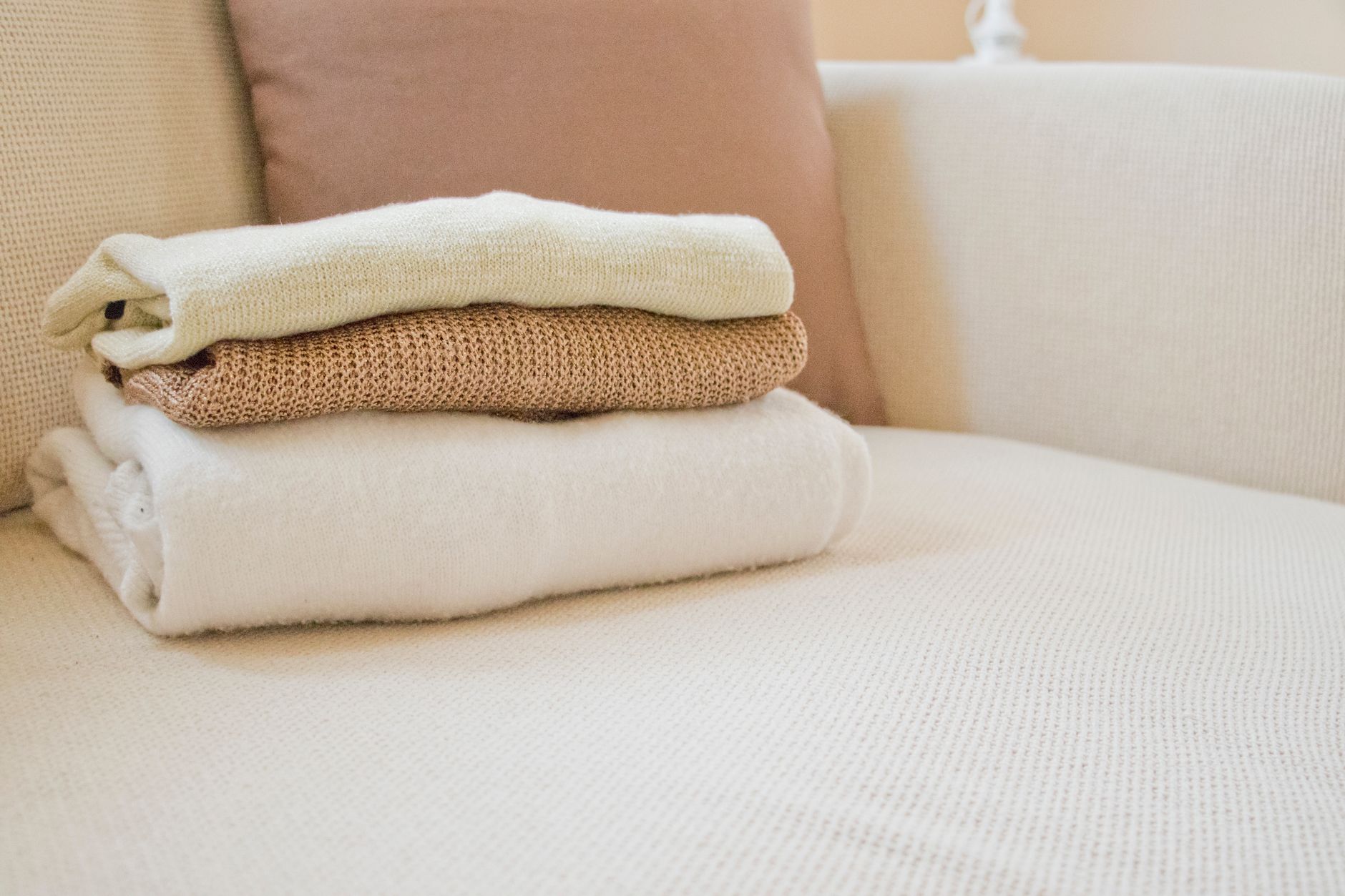 Photo by Ralitsa Racheva via Pexels
Store knits folded rather than hung. It isn't a pilling fix directly, but a stretched-out knit is a looser knit, and a looser knit pills more.
How to use a fabric shaver without thinning the knit
A fabric shaver removes pills by cutting them off, which means every pass also removes a little fiber. Use it carelessly and you trade pills for a thin, see-through patch. The technique is about removing the pill and nothing else.
- Lay the cardigan flat on a hard surface, smoothed but not stretched. Stretching opens the knit and lets the blades reach into it.
- Check the guard height, if your shaver has an adjustable one. Start with the setting that keeps the blades farthest from the fabric and only move closer if pills are being missed.
- Use almost no pressure. Let the shaver's weight rest on the fabric and glide it in light, slow passes. Pressing down pushes the knit up into the blades, which is how holes happen.
- Work on the pills, not the whole area. Go over a pilled patch a few times, then stop. Don't chase the faint fuzz left behind; that fuzz is the sweater's surface.
- Empty the lint chamber often, because a full chamber makes the shaver drag and tempts you to press harder.
Shave when pills are visible, not as a routine. Each session costs fiber, so a cardigan shaved every weekend thins faster than one shaved when it actually needs it.
For fine cashmere or a very loose knit, skip the electric shaver. A sweater comb pulled lightly in one direction, or small sharp scissors to snip individual pills, takes longer but removes less of the garment. Avoid a disposable razor on fine knits; one slip catches a stitch.
Before you buy the next one
Run the same short checklist every time. Read the fiber content and decide which kind of pilling you're signing up for. Rub a hidden seam for ten seconds. Hold a layer up to the light. Stretch a small section and watch whether it springs back. Choose a smooth, defined stitch over a fuzzy one if durability matters more to you than that first-touch softness.
A cardigan that passes all four checks can still pill a little where your bag rests. That's ordinary wear, and a few careful minutes with a shaver handles it. A cardigan that fails the rub test in the store will look old by next month regardless of what you paid for it, so leave it on the shelf.
Frequently asked questions
Does pilling mean my cardigan is low quality?
Not necessarily. Soft, loosely spun yarns such as cashmere pill readily even when they're expensive, and most natural-fiber knits pill somewhat in their first weeks of wear. Pilling everywhere after a single wash, or pills made of a synthetic blend that never shed, is a better sign the knit itself is the problem.
Will my cardigan eventually stop pilling?
If it's a single natural fiber like wool or cashmere, pilling often slows down once the loosest fibers have worked out, because those pills tend to break away. If it's acrylic or blended with nylon or polyester, the synthetic fibers hold pills on the surface, so expect to keep removing them.
Is a lint roller enough to remove pills?
A lint roller picks up loose fuzz and pills that are barely attached, but pills anchored into the yarn need to be cut off with a fabric shaver, a sweater comb, or small scissors. Pulling them off by hand drags more fiber out of the yarn and starts new pills.
How often should I use a fabric shaver on a sweater?
Only when pills are visible, not on a schedule. Every pass removes some fiber along with the pills, so frequent routine shaving thins the knit faster than the pilling would.